The post The Missing Chapter at Work: Closing the Menopause Talent Gap appeared first on Global Wellness Institute.
]]>
Author: Talya Landau Bsc, CHC
Workplaces have spent the last two decades building policies that support maternity and early parenthood. But they skipped the next chapter: menopause. There is a conversation happening in millions of workplaces – in hushed tones, in hallway conversations, and during quick breaks between meetings. It is a conversation about hot flashes during board meetings, brain fog that erodes confidence, and exhaustion that makes even the most capable leaders question themselves. And most organizations still pretend it isn’t happening.
Caught Between Silence and Stigma
Over the past several decades, the progress of feminism has brought enormous gains, integrating women into a wide range of professions and leadership roles. At the same time, life expectancy has increased and careers have become longer. Together, these shifts have created a new reality the world of work has never fully confronted before: large numbers of experienced women are navigating menopause during the peak years of their professional impact. Yet workplace systems were not designed with this stage of life in mind.
In conversations with women in senior leadership and executives across organizations, the same pattern emerges again and again. On one side are highly experienced women – leaders with decades of expertise, navigating menopause quietly. Many do not want to appear weak. They worry about being perceived as less capable or less reliable. In workplaces that still reward constant strength and control, vulnerability can feel risky. So, they manage the experience privately. On the other side, HR leaders and executive teams often express a different dilemma. Many genuinely want to support women better. But they worry about unintended consequences. Would menopause policies reinforce stereotypes about women being unstable leaders? Would managers start quietly favoring younger employees? Could well‑intentioned support actually backfire?
These are not theoretical concerns. They reflect real tensions inside organizations trying to balance support with perceptions of fairness and performance. Interestingly, some of the strongest resistance to menopause policies sometimes comes from women themselves, who feel this is simply a personal issue they must manage on their own. The result is a difficult tension. Speak up about menopause and risk being seen as “high‑maintenance.” Stay silent and carry the physical and emotional load alone. Neither path is fair. And neither serves organizations.
Menopause is not a private problem to be managed quietly. It is a predictable life transition – much like pregnancy, parental leave, or recovery from surgery – that millions of people experience during what are often their most experienced and valuable professional years. When workplaces ignore this reality, symptoms are often misinterpreted. Difficulty concentrating becomes disengagement. Fatigue becomes a perceived loss of ambition. Requests for small adjustments are interpreted as “being difficult.” The result is real talent, real knowledge, and real leaders leaving organizations. For organizations investing heavily in performance excellence, leadership pipelines, and diversity initiatives, this represents a significant, and often invisible, loss of experience.
The Numbers That Should Wake Us Up
Menopause is not a single moment but a transition that can span several years. Perimenopause alone may last anywhere from two to ten years, often beginning in the 40s, and many women experience symptoms such as hot flashes, night sweats, disrupted sleep, fatigue, and changes in concentration or memory. These symptoms can directly affect daily work performance. This is not a niche issue. By 2030, the global population of menopausal and post‑menopausal women is projected to reach around 1.2 billion. Many of these women will be active members of the workforce, often in senior or highly skilled roles.
The economic implications are substantial. Research from the McKinsey Health Institute estimates that closing the global women’s health gap – with menopause as a major contributor – could add approximately 1 trillion US dollars to the global economy annually by 2040. Employee expectations are also shifting. A multi‑country survey from Catalyst found that 84% of respondents believe employers should provide more menopause support, and more than one‑third say their symptoms have already affected their work performance.
Despite business and economic implications, only a small percentage of organizations currently have formal menopause policies or workplace support structures in place. Legal and regulatory signals are also beginning to emerge. In the UK, employment tribunals have already ruled in favor of women who experienced harassment or unfair dismissal related to menopause symptoms, with some cases recognizing menopause‑related impairments as potential disabilities under the Equality Act. The UK is leading with binding legislation, and Australia, the United States, and EU nations are advancing policy frameworks and workplace guidance that embed menopause within occupational health and equality.
The Cultural Tipping Point
For decades, menopause remained largely invisible in public discourse. Today, it is increasingly discussed in mainstream media, podcasts, and professional forums. Clinicians, researchers, journalists, and women leaders are speaking more openly about the realities of midlife health. At the same time, a growing wave of femtech innovation is focusing specifically on menopause – from symptom‑tracking apps and wearables to virtual‑care platforms designed to support midlife women’s health. This reflects both the scale of the need and the expectation that this life stage should be taken seriously. For employers, this moment presents an opportunity to move from awareness to thoughtful, evidence‑based action.
Five Things Organizations Can Do
Policy – make menopause visible and legitimate
Formal policies signal that menopause is a recognized, legitimate workplace topic rather than a private burden. Effective policies typically:
- Define menopause and perimenopause as health transitions that may sometimes require adjustments, similar to pregnancy or other long-term conditions.
- Clarify the types of support and reasonable adjustments available, such as flexible work options, access to quiet spaces, or temporary changes in uniform.
- Outline confidentiality, documentation, and referral pathways, such as occupational health or employee assistance programs.
- Align with equality, health and safety, and anti-discrimination policies to reduce legal risk.
Flexibility – design work with variability and recovery in mind
Many menopause-related difficulties are episodic. Symptoms may flare unpredictably, especially around sleep disturbance, heavy bleeding, or mood changes. Employer case studies and workplace surveys, and industry reports, highlight the value of relatively small adjustments, such as:
- Flexible start and end times, especially after nights of poor sleep.
- Options for remote or hybrid work on challenging days.
- The ability to step away briefly from meetings or public-facing roles without penalty.
- Protected time for medical appointments and evidence-based treatment.
The goal is not to create a separate category of work for midlife women, but to design flexibility that is grounded in outcomes and available on a fair, transparent basis.
Leadership – equip managers for informed, humane conversations
Managers sit at the interface between policy and everyday experience. They do not need to diagnose or treat menopause, but they do need to:
- Understand that menopause can affect concentration, mood, energy, and confidence in ways that may show up in performance.
- Recognize when a change in behavior might have a health dimension and create space for confidential discussion.
- Use clear, compassionate language, focusing on what the employee needs to do their job sustainably.
- Work collaboratively to identify adjustments that support both the individual and the team.
Environment – make physical spaces work for midlife women
Physical environments can make symptoms either harder or easier to manage. Many helpful changes are low-cost and benefit a wide range of employees, not just those experiencing menopause. Examples include:
- Improving ventilation and access to fans or cooler spaces.
- Providing easy access to drinking water and restrooms.
- Allowing variations in dress code, for example lighter layers and breathable fabrics.
- Ensuring private spaces where employees can briefly cool down, rest, or change clothes.
When integrated into broader workplace design, these adjustments send a signal that the organization takes midlife health seriously.
Community – reduce isolation and normalize the conversation
Many women report feeling isolated or worrying that raising concerns about menopause at work will be seen as unprofessional. Global survey data from Catalyst suggest that employees are more likely to stay and perform well when they feel understood and not alone. Employers can help by:
- Creating voluntary employee resource groups or peer networks focused on midlife health.
- Hosting internal webinars or panels featuring medical experts and employees who choose to share their experiences.
- Posting signage about high-quality, evidence-based resources rather than commercial products.
- Involving allies of all genders and ages to avoid framing menopause as a “women-only problem.”
Conclusion
Organizations that address menopause thoughtfully will do more than expand their benefits offering. They will protect institutional knowledge, strengthen leadership continuity, and build workplaces that support employees across the full arc of their careers. Addressing menopause at work contributes directly to closing the broader women’s health gap. Menopause doesn’t have to remain the missing chapter of working life. Not if we choose to write it.
Supporting References
Delanerolle G, et al. Menopause: A Global Health and Wellbeing Issue That Needs Urgent Attention. The Lancet. 2025; 13(2): E196-E198.
D’Angelo S, et al. Impact of Menopausal Symptoms on Work. International Journal of Environmental Research and Public Health. 2022; 20(1):295.
McKinsey Health Institute. Closing the Women’s Health Gap: A $1 Trillion Opportunity to Improve Lives and Economies. January 17, 2024.
Pritchard J. 5 Ways Employers Can Get Ahead with Menopause Action Plans. Reward & Employee Benefits Association. January 13, 2026.
The Menopause Society. Menopause and the Workplace: Consensus Recommendations from The Menopause Society. The Journal of The Menopause Society. 2024; 31(9): 741-749.
UK Equality and Human Rights Commission. Menopause in the Workplace: Guidance for Employers. February 2024, Updated August 2025.
About the Author
Talya Landau is a Workplace Wellbeing Strategist and Keynote Speaker, and the founder of Shmone — a wellbeing company specializing in Strategic Wellbeing Programs, energy renewal, and burnout prevention. Drawing from her experience as Global Wellbeing Manager at Wix.com and Director of Innovation at Amdocs, she helps companies worldwide drive real change in the future of work. Talya is passionate about making a difference through proactive health and wellbeing initiatives. She is an active member of the Global Wellness Institute’s Workplace Wellbeing Initiative.
**Disclaimer**
The blog submissions featured on this site represent the research and opinions of the individual authors. The Global Wellness Institute and the Workplace Wellbeing Initiative are not responsible for the content provided. The views expressed are solely those of the authors and do not necessarily reflect the official policy or position of the Global Wellness Institute or the Workplace Wellbeing Initiative. Readers are encouraged to consult with a qualified healthcare professional for specific health concerns.
The post The Missing Chapter at Work: Closing the Menopause Talent Gap appeared first on Global Wellness Institute.
]]>The post What’s Next for the Future of Wellness? appeared first on Global Wellness Institute.
]]>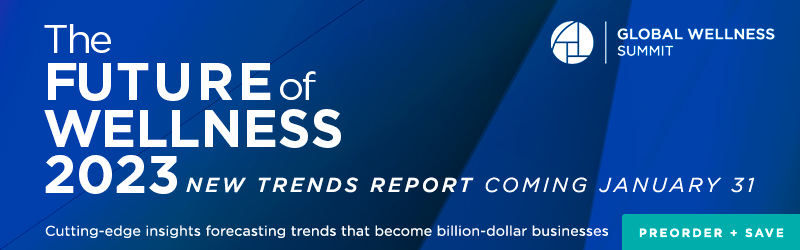
New Global Wellness Trends Report
To Be Released January 31 at the Annual GWS/GWI Press Event
The Global Wellness Summit’s annual trends report, The Future of Wellness, has garnered a reputation for predicting billion-dollar new sectors.

We predicted a booming Wellness Travel sector before anyone even used the term.
Now it’s the fastest growing travel sector. The Global Wellness Institute predicts an impressive 21% annual growth rate, expanding the sector to an over $1 trillion market by 2024.

We predicted mushrooms would explode in wellness before they became a multi-billion-dollar mainstream market.
Since then, a plethora of new medical evidence exists on how psilocybin can treat depression, addiction and anxiety; and mushrooms are widely recognized as a functional superfood.

We predicted “A New Feminist Wellness” when it was still taboo.
Six years later, we are seeing femtech companies become unicorns at unprecedented rates and a flood of groundbreaking companies emerge addressing fertility, menopause, sexual health and more.
Preorder the 2023 Future of Wellness global trends report to see what’s next.
The Future of Wellness is the only wellness forecast that draws from the insights of the renowned economists, medical and wellness professionals, academics and leaders across all sectors—from travel to spa to beauty to tech to architecture and more—who attend the annual Global Wellness Summit. Our long track record of accurately predicting trends makes this report the “go to” authority on wellness trends for anyone in the industry. Preorder the digital report before it is released on January 31 to save $20 and be the first to know the meaningful shifts impacting the business of wellness.
LEARN MORE + ORDER
Savings end January 31.
$95 $75
The post What’s Next for the Future of Wellness? appeared first on Global Wellness Institute.
]]>