The post Mixing Up Exercise Linked to Longevity appeared first on Global Wellness Institute.
]]>
A 2026 study from Harvard, analyzing 30 years of data from 100K+ Americans, found that diversifying your movement may have a big impact on your lifespan. The researchers found that people that did the highest variety of exercise––whether walking, gardening or weightlifting––had a 19% lower risk of premature death compared to those who engaged in the lowest variety, even when total physical activity was held constant. The findings add a new dimension to the well-established link between exercise and longevity.
Access the study
Curious for more? Explore the evidence behind wellness here.
The post Mixing Up Exercise Linked to Longevity appeared first on Global Wellness Institute.
]]>The post Wellness Real Estate Case Study appeared first on Global Wellness Institute.
]]>
Wellness Real Estate Case Study
American Cancer Society Richard M. Schulze Family Foundation Hope Lodge
Houston, Texas, United States
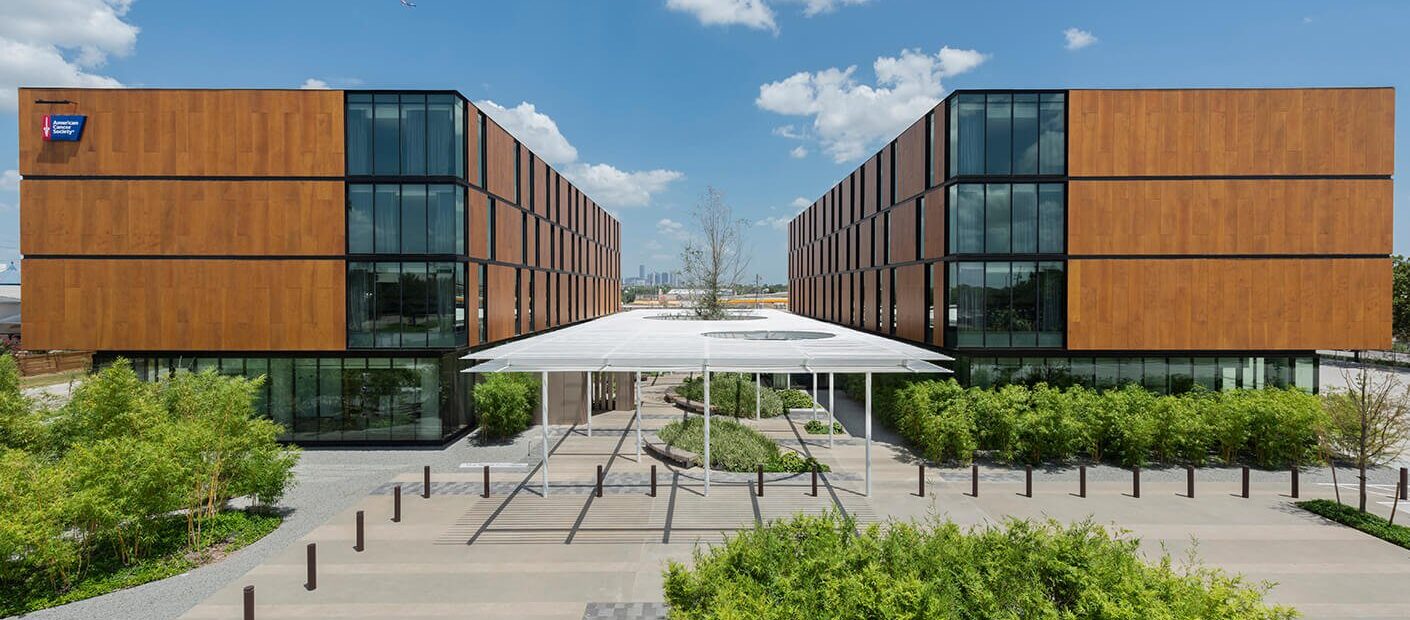
The American Cancer Society Richard M. Schulze Family Foundation Hope Lodge© in Houston, Texas (henceforth referred to as Hope Lodge Houston) is one of the newest among more than 30 American Cancer Society (ACS) Hope Lodges located across the United States. Cancer treatment is stressful, time-consuming and expensive; for patients who need to travel far away from home to receive treatment, there is the added financial burden of paying for lodging, food and transportation. The ACS Hope Lodge program, founded in 1970, aims to provide a free home away from home for cancer patients and their caregivers when they travel for treatment. Hope Lodge Houston, which opened in 2021, is a 64,000 square feet facility located near the Texas Medical Center campus and its various hospitals and cancer treatment centers. The lodge offers 64 one-bedroom suites free of charge, on a first-come, first-served basis, to qualified patients undergoing active cancer treatment, through referral by their treatment centers. There is no limit to how long patients can stay—some have stayed for up to a year or more—as long as they continue to be in active treatment. While there is no housekeeping service, the lodge provides free linens, laundry facilities and cleaning supplies to guests. Hope Lodge Houston is essentially a hospitality complex hosting guests with medical conditions and specialized needs, staffed by professionals as well as a group of dedicated volunteers. According to Perkins&Will, the overall design of Hope Lodge Houston “seeks to develop a building as a sanctuary, providing refuge and a sense of rejuvenation and hope, helping to generate the energy and camaraderie necessary to promote the healing process.”1
Distinctive approaches to wellness
Do no harm to cancer patients
One of the guiding principles for wellness real estate is to “do no harm,” or making sure that a building’s materials, design and operations do not bring harm to its occupants. At Hope Lodge Houston, the main occupants are cancer patients undergoing active treatment. With this in mind, the designers decided to take the “do no harm” principle to the highest level, knowing that guests are recovering from recent surgeries, or may have mobility issues, compromised immune systems, or heightened sensitivity to allergens, smells and noise. Careful consideration was given to every aspect of the building’s materials, design, environment and operations, to ensure that they are as healthy as possible. The design team hired an industrial hygienist to analyze the water and air around the site and assess the need for filtration. Finding an uncomfortable amount of petroleum byproducts in Houston’s water supply, the team decided to install an advanced water filtration system to deliver the highest quality water within the building. Due to air quality concerns, the design team decided against using natural ventilation (i.e., windows do not open). The mechanical system was designed to provide space downstream of primary MERV 13 filters for future carbon filters. The team also examined more than 80 different building materials and substances of concern within them, to ensure they are safe for immunocompromised occupants. “We’re housing people with cancer, so we don’t need to expose them to more carcinogens,” said Tori Wickard, an architect on the design team.
A lot of thought went into the spatial design, as well as the selection of interior finishes, furnishings and materials that do not trap dust and are easy to clean. The design team adopted a hospital-like mindset about preventing infections, while still trying to create spaces that are not clinical or antiseptic-looking. Suites are designed to be acoustically private to minimize disturbances to guests. Due to the heightened olfactory sensitivity of some cancer patients, and their reactions to cooking smells, commercial-grade exhaust fans are installed over all cooking stoves and ventilate directly to the outside. Deliberate physical barriers (glass walls and doors) separate the community kitchen and dining areas from the rest of the lodge to reduce the spread of food and cooking smells.
Harnessing biophilia for physical, mental and social wellbeing
Going through cancer treatment is stressful for both patients and their caregivers, so guests at Hope Lodge Houston appreciate being in an environment that strengthens their feelings of wellness and resilience. The design team incorporated biophilia as a central principle throughout the facility to create a human-centered and healing environment. Hope Lodge Houston comprises two four-story buildings connected by a low-rise structure that houses the reception area, offices, meeting/gathering spaces and communal kitchen and dining area. The buildings frame an interior courtyard, or cloister, with a Healing Garden that brings rejuvenating natural light into all interior spaces. All guest rooms and communal spaces (waiting, lounging, dining and socializing areas) have a view of the garden, giving occupants the benefit of a tranquil view of nature and beauty. On a practical level, the design team said that this arrangement also shields occupants from the noise and vehicular exhaust from the exterior surrounding highways and high-traffic roads. Views of nature are crucial to delivering biophilic benefits at Hope Lodge Houston because indoor plants are not feasible in this kind of facility; in fact, potted plants or floral arrangements are strictly not allowed in the building because pollen and other allergens can affect cancer patients. Other biophilic elements include interior finishings dominated by wood and natural materials in neutral colors. The large, floor-to-ceiling windows let in ample natural light, and the feeling of being connected to nature and daylight can bring patients a sense of energy, rejuvenation and optimism.
Cooking and sharing food for healing and community
Healthy eating is a key pillar of wellness. For cancer patients, being able to cook healthy meals is not only important for nourishment but also a financial relief from ordering restaurant food or buying pre-prepared meals. Besides the Healing Garden, the other centerpiece of Hope Lodge Houston is the community kitchen and dining room. The community kitchen is very spacious, with plenty of stoves, cookware, dishware and dishwashing machines. Each guest is provided a designated kitchen storage area, as well as refrigerator/freezer spaces. Since all guests have traveled away from home, far from their usual support systems, it is important that they find community and social connections in an otherwise isolating circumstance. To cook and eat at Hope Lodge Houston is to see prosocial design at work. The community kitchen and dining room is essentially the facility’s social hub—where caregivers from all over the country and the world cook alongside one another, sharing recipes, equipment and food; where patients swap cancer war stories and trade advice on hospitals, doctors, treatment options and medical insurance; and where guests offer each other solidarity, comfort, support and encouragement during their cancer journeys. There is also celebration whenever a guest finishes treatment and checks out to go home. The community kitchen space is designed to provide a homelike environment and enable a nurturing community where guests become one another’s support systems.
To learn more about this case study and others, see GWI’s Build Well to Live Well: Case Studies, Volume 1.
The post Wellness Real Estate Case Study appeared first on Global Wellness Institute.
]]>The post Social Media Is About to Have Its Big “Tobacco” Moment appeared first on Global Wellness Institute.
]]>
Social Media Is About to Have Its Big “Tobacco” Moment
And it will go beyond regulating teens
By Thierry Malleret, economist
Earlier this month, Spanish Prime Minister Pedro Sanchez said that “social media has become a failed state,” echoing the rising concerns of many policymakers and experts about the dangers it poses. The push to ban some digital platforms to users under a certain age is gaining traction, most notably in Europe with countries like Austria, France, Denmark, Germany, Greece, Spain and the UK considering a ban for those under 16. In the US, around two dozen states are exploring laws aimed at restricting access to social media or requiring age verification for teenagers. There is certainly a growing recognition (supported by scientific evidence, which so far remains limited) that digital platforms like TikTok, Grok, Facebook and Instagram negatively affect our cognitive, mental and physical wellbeing.
This said, some question marks remain about whether banning teenagers from social media could do more harm than good. As demonstrated by Australia—the first country to put in place a ban on social media consumption for teenagers last December—evaluating the effectiveness of such a policy can be tricky. After the initial four months, practical experience shows that enforcing a ban is very hard (mainly because of VPNs), and so is defining what social media really is. For example, WhatsApp—having escaped the ban— is now used by many Australian teenagers as a social media platform. Is the messaging app evolving into a social media platform?
Despite the vagaries of legislation, it’s likely that social media is living, or about to live, its big tobacco moment. Naturally, big tech is fighting back. Elon Musk denounced Pedro Sanchez as a “tyrant” and “fascist totalitarian,” framing the whole issue as one of freedom of speech and authoritarian censorship. For Europe, regulating social media platforms is almost certain to inflame tensions with the current US administration–and this is the point where wellness, geopolitics and tech intersect and collide.
From a global standpoint, the broader and fundamental question for the wellness community is: how do we protect ourselves from social media without depriving ourselves of its benefits? Today, the conversation is focused on children and teenagers, but is there any age at which someone becomes old enough to escape social media addiction and to digest unlimited amounts of hate, abuse, addictive material and violent pornography without mental harm? Similarly, is there a limit in terms of the time we should spend talking to an online chatbot? Finding, or providing, protection against social media excess and overconsumption goes beyond defining an age limit. It must also be a question of defining a “wellness limit,” the threshold beyond which too much social media becomes incompatible with a person’s wellbeing.
The post Social Media Is About to Have Its Big “Tobacco” Moment appeared first on Global Wellness Institute.
]]>The post Countries With the Fastest and Slowest Growing Wellness Markets appeared first on Global Wellness Institute.
]]> Countries With the Fastest and Slowest Growing Wellness Markets
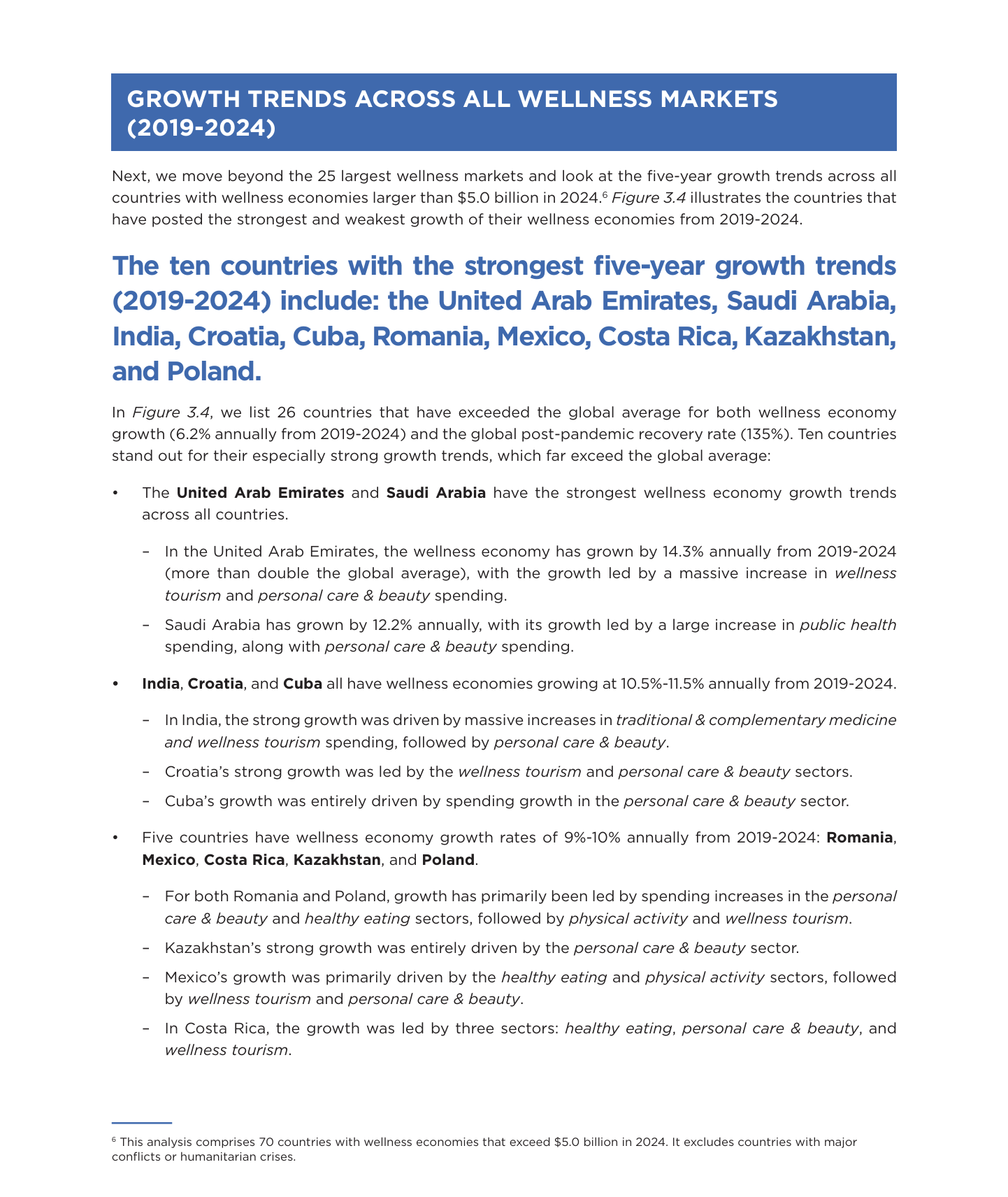
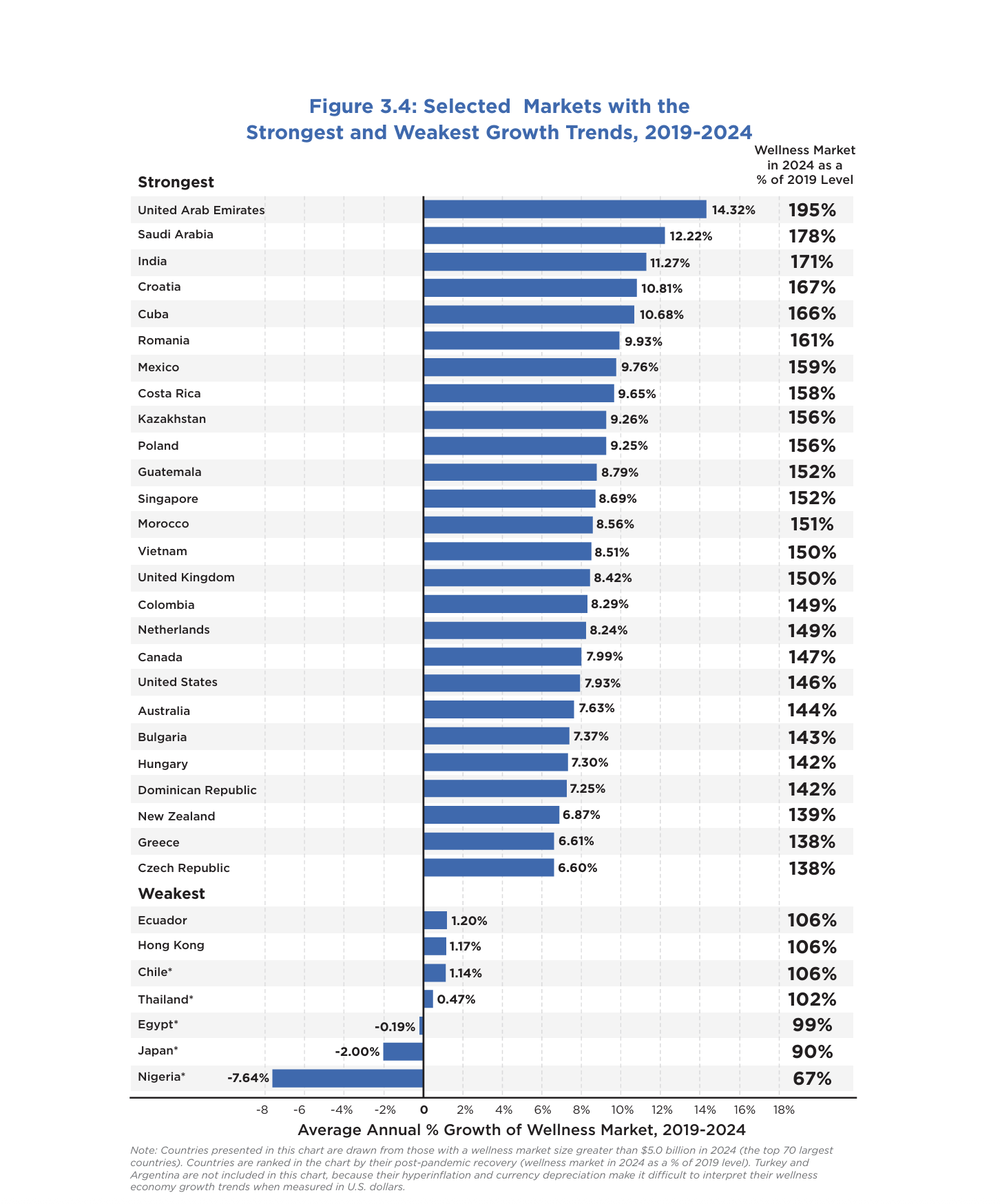
GWI’s new “Country Rankings” report is packed with data on the wellness markets of 145 countries. It reveals which nations are the five-year growth leaders, and which wellness markets are experiencing the slowest growth. The Middle East is a big story: The UAE (14.3% annual growth) and Saudi Arabia (12.2%) rank first and second among all countries for recent expansion. Other growth stars: India, Croatia, Cuba, Romania, Mexico, Costa Rica and Kazakhstan. The nations with the weakest wellness market growth? Ecuador and Hong Kong.
Download your copy of the Global Wellness Economy: Country Rankings (Data for 2019-2024)
The post Countries With the Fastest and Slowest Growing Wellness Markets appeared first on Global Wellness Institute.
]]>The post Snapshots of EVERY wellness sector: the trends driving each market appeared first on Global Wellness Institute.
]]>
Snapshots of EVERY wellness sector: the trends driving each market
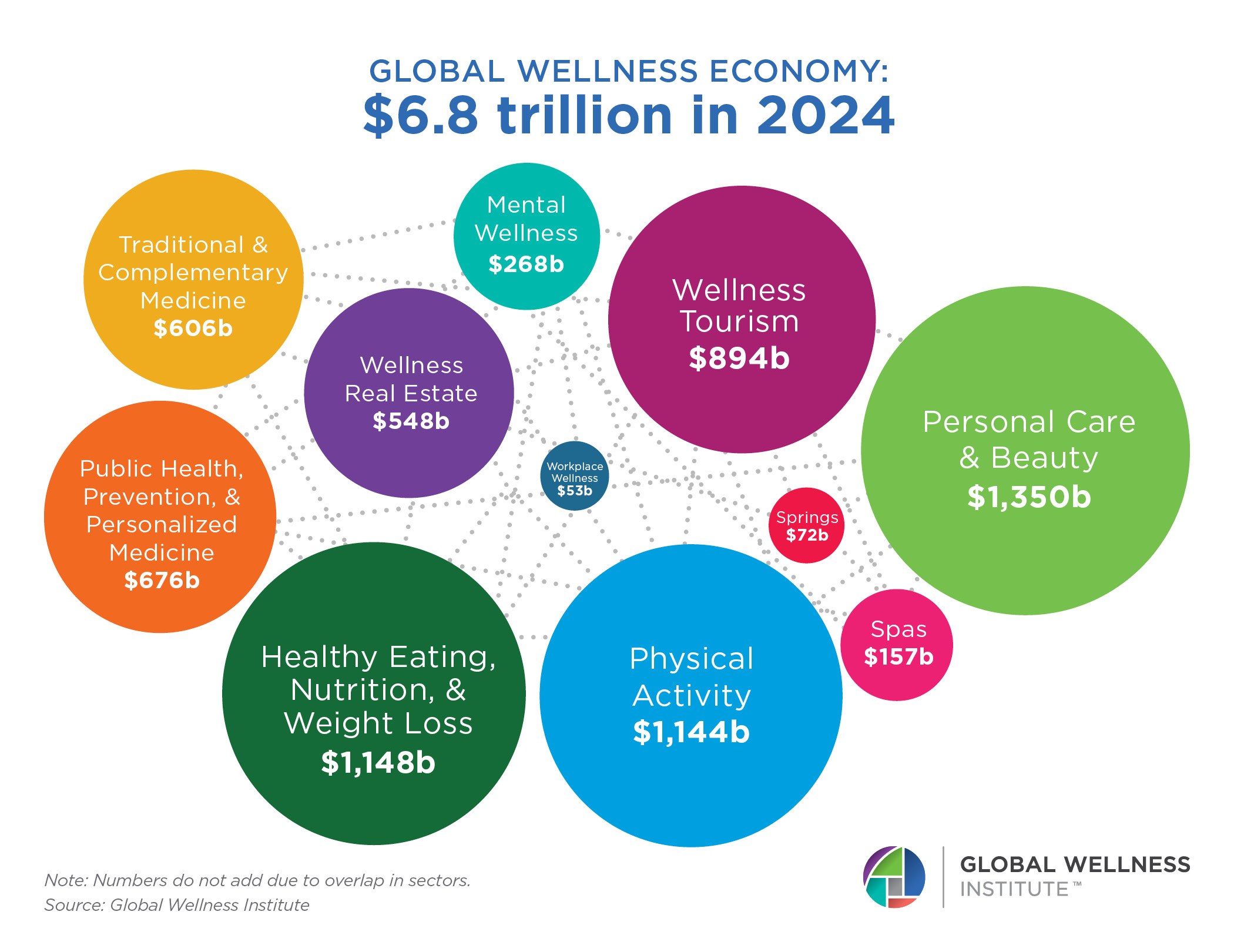
When GWI released the in-depth Global Wellness Economy Monitor 2025 last month, revealing that the wellness economy had reached a new peak of $6.8 trillion, it included a first: a chapter that––succinctly but with detail––provides some nuance and “color” to all the in-depth data in the report.
For each of the 11 wellness markets––whether wellness tourism or physical activity or wellness real estate––it lays out the big market shifts and the powerful consumer trends that are driving the growth and evolution in each sector, both in the last few years and into the future. From why mental wellness is a category with such eye-opening growth (and the subsectors that are driving it) to why the personalized medicine market subsection in the ‘Public Health, Prevention & Personalized Medicine’ segment will see such unprecedented growth through 2029, this chapter really paints the picture of each market and its subsectors, and what’s driving change.
If you want a crash course in each wellness market (or just one), it provides some good––and edifying–– holiday reading.
DIVE IN! And Happy New Year!
DOWNLOAD THE BUBBLE CHART AND KEY GRAPHS
The post Snapshots of EVERY wellness sector: the trends driving each market appeared first on Global Wellness Institute.
]]>The post Must Reads from the Wellness World appeared first on Global Wellness Institute.
]]>
Weight loss drugs like Ozempic are lowering the US obesity rate–Gallup News
A new Gallup poll indicates that the rate of obesity among US adults has declined over the past three years as GLP-1 use by adults rose sharply from 6% in early 2024 to 12% today. Obesity fell from 40% of the population in 2022 to 37% in 2025 (the equivalent of 7.6 million fewer obese people). The age group most likely to use weight-loss drugs is those aged 50 to 64 (17%), and that group also saw the biggest decline in obesity (-5%). But Gallup also found that the diabetes rate has climbed to an all-time high of nearly 14% of the adult population.
More governments and schools are banning social media–The New York Times
Bullying. Body-shaming. Self-harm. Unhealthy relationships with A.I. chatbots. Teenagers can’t seem to put down their phones. As public concern over youth mental health has mounted, lawmakers have rushed to curb young people’s access to social networks. Schools have banned phones. Instagram, TikTok and Snapchat have introduced new teen safeguards. Now, Australia is going very far with a sweeping social media ban for teenagers. This article explains what we know so far as to whether the bans help.
How a radical experiment to bring a forest into a preschool transformed children’s health–The Guardian
In Finland, a first-of-its kind study had kindergartens expose children to more digging in the mud and wild plants and moss, and found significant changes to their health, revealing how crucial biodiversity and exposure to soil microbes is to wellbeing. It compared the green/rewilded day care centers with ones covered in asphalt, sand and plastic mats and found that kids from the green kindergartens had less disease-causing bacteria on their skin and stronger immune defenses, including an increase in T regulatory cells in the blood that protect the body from autoimmune diseases. The interest in bringing dirt and nature into preschools and kindergartens is spreading.
Longevity Secrets of the Animal Kingdom––Nautilus
All living things eventually die. Some, like humans, try to postpone the inevitable goodbye for as long as possible. This is why longevity (enabled by better science) is currently everywhere. But as it happens, some nonhumans from the animal kingdom age without suffering the ignominy of the conditions contingent with human old age: cancerous cells, degenerated brains, diseased hearts. Why do some animals beat the odds and cheat death longer than most? This article reports on findings from scientists who’ve been studying long-lived creatures, and how they are working to use what they discover to extend human lives. Dives into the longevity secrets of bowhead whales, naked mole rats, immortal jellyfish and others.
Want to be more productive? Start by doing less––Big Think
“In most instances, ‘good enough’ is good enough.” In this three-minute video, three top researchers—time management expert Oliver Burkeman, Yale cognitive scientist Laurie Santos and organizational psychologist Melanie Katzman—discuss the illusion of perfectionism, the limits of productivity and the harm of burnout and hustle culture. According to their research, the constant drive to improve leaves people more exhausted and less productive, even if their intentions were to grow or achieve bigger goals. Together, they explain how accepting “good enough” and finding value beyond work can lead to greater balance and happiness.
A Striking Stat:
Deaths linked to air pollution in Southeast Asia are estimated to rise by 10% by 2050, costing the region nearly $600 billion.
Source: Environment International, Nov. 2025 edition
The post Must Reads from the Wellness World appeared first on Global Wellness Institute.
]]>